
by rtdosen | Dec 16, 2014 | Ryan Dosen Real Estate Articles
3 Percent Down Conventional Home Loan Financing for First-Time Home Buyers By Ryan Dosen Cash-strapped first-time home buyers caught a big break this week. Fannie Mae and Freddie Mac announced that they are adopting programs that will allow first-time home buyers to put as little as 3 percent down towards the purchase of a home. Similar programs are offered through the FHA, but the backing of Fannie Mae and Freddie Mac will make the terms much more favorable for well-qualified first-timers. This new 97 percent loan-to-value program officially becomes available on December 13, 2014. “First-Time” Home Buyers? Government-sponsored enterprises (GSEs) Fannie Mae and Freddie Mac are allowing “first-time” home buyers to qualify for their new 3 percent down programs. Fannie and Freddie define “first-time” home buyer as someone that has not owned a home in the last three years. So, you may qualify as a “first-time” home buyer even if you’ve previously owned a home. Fannie Mae will also let you qualify as “first-time” home buyers if one, but not both buyers qualify as a first-timer. Conventional Loans and Financing Fannie Mae and Freddie Mac’s new 97 percent loan-to-value program (the previous max was 95 percent loan-to-value) is only for conforming or conventional loans. Fannie and Freddie set various standards for loans that they will back or buy from banks. Loans that meet these standards are considered conforming or conventional. When a bank issues a loan, it can keep the loan on its own books or potentially package the loan with other loans and sell them off. The selling off of loans enables banks to stay...
by rtdosen | Dec 5, 2014 | Ryan Dosen Real Estate Articles
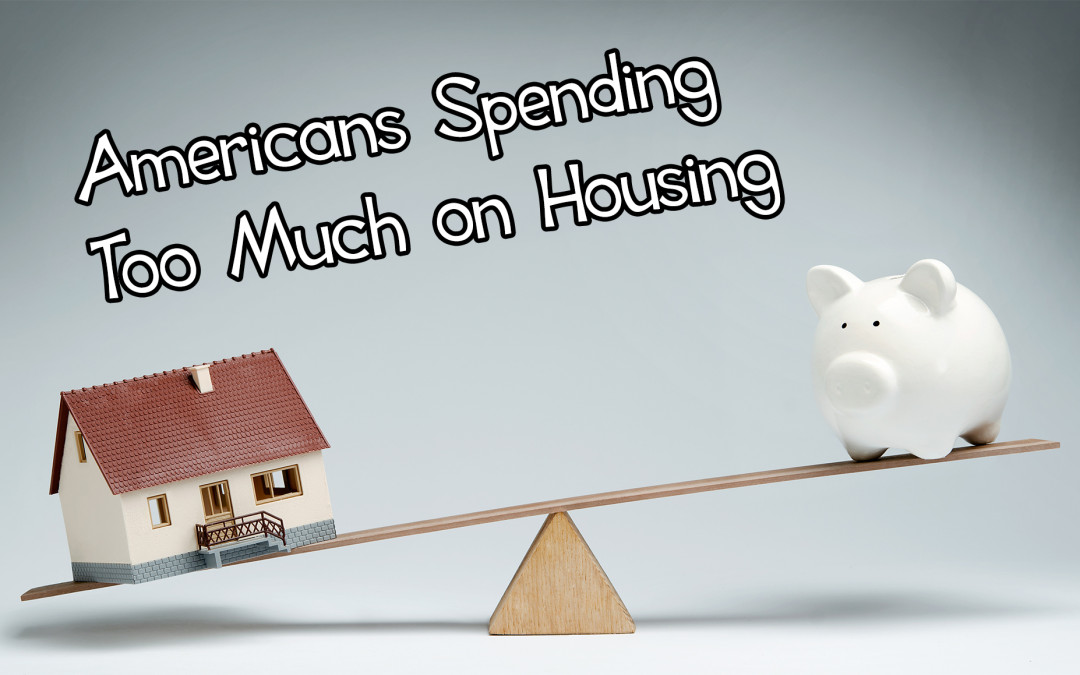
Americans Spending Too Much on Housing By Ryan Dosen CNNMoney.com recently reported that too many Americans are spending too much of their money on housing. Some are stretching their dollars to get the nicest homes they can possibly afford. Others are struggling with low wages, underemployment, bad credit, and/or high rental costs that could be unsustainable, individually and societally. 40 Million “Cost Burdened” Americans The Demand Institute, a non-advocacy and non-profit division of The Conference Board, is a think tank that focuses on understanding how consumer demand changes in industries, countries, and markets. The Institute recently surveyed 10,000 U.S. households and found that nearly 40 million Americans are spending more than 30 percent of their income on housing payments, property taxes and other home expenses. Even worse, 49 percent of renters are finding themselves in this “cost burdened” zone. Another study released this summer by Harvard’s Joint Center for Housing Study reported that housing costs are near record highs and that 28 percent of renters are “severely” cost-burdened with housing costs eating up at least half of their incomes. Debt-to-Income Ratios When qualifying you for a loan to purchase a home, a bank will look at your debt-to-income (DTI) ratios. There are two DTI ratios that are relevant when trying to qualify for a mortgage: front-end ratio and back-end ratio. Local mortgage expert Karen Jackson of Waterstone Mortgage in West Chester says that the front-end ratio is the percentage of monthly gross income that is taken up by just the new projected monthly “PITI” (principal, interest, taxes, and insurance) payment. The back-end ratio is the percentage taken...

by rtdosen | Nov 26, 2014 | Ryan Dosen Real Estate Articles
Code Concerns Can’t Cool Builder Expectations By Ryan Dosen Builders, faced with increasing costs and stricter building codes, remain optimistic about the future and the demand for their product. The National Association of Home Builders (NAHB) just reported a Housing Market Index (HMI) of 58—the second highest monthly reading in 9 years. Despite their optimistic mindset, some builders still feel the walls closing in with the onset of high-cost, low-return code mandates. Stricter Building Codes Paul Emrath of the NAHB wrote that “originally, building codes were designed to establish minimum safety standards for newly built structures, but codes have increasingly been seen as a tool for advancing other public policies, such as energy efficiency.” Emrath says that this trend is causing builders to become concerned about some of the code changes increasing costs “substantially, as well as needlessly.” The NAHB/Wells Fargo Housing Market Index polls home builders every month to gauge their sentiment for the housing market. October’s HMI survey asked builders a new question: “How concerned are you about building codes becoming too stringent and driving up costs without a measurable improvement in safety or other benefits.” Builders were asked to respond on a scale of 1 to 5, with 1 being “not concerned at all” and 5 being “extremely concerned”. 35 percent of surveyed NAHB members responded to October’s new survey question by stating that they were “extremely concerned” about building codes overall becoming “too stringent and driving up costs without a measureable improvement in safety or other benefits.” Only 6 percent of surveyed home builders reported that they were not concerned at all. 58 percent of...

by rtdosen | Nov 17, 2014 | Ryan Dosen Real Estate Articles
Top 5 Home Selling Myths By Ryan Dosen Selling your home may be the last thing on your mind this time of year. The holidays are coming. Maybe the in-laws are coming, too. There will be presents to wrap, parties to plan, turkeys to roast and plenty of things to do other than thinking about selling your home. You’ll worry about that in the spring, right? Well, let’s take a look anyway. Maybe you’ll think twice. Myth number 1: Price it High; You Can Always Come Down Later When looking to sell a home, every seller should want to achieve the highest price possible. So, naturally, the inclination for sellers is to price their homes high and near the maximum they could conceivably achieve on the open market. They say they want to test the waters. You never know, right? I mean, couldn’t that random person come along with a giant bag full of money and absolutely fall in love with your home? And maybe they’d be willing to pay whatever you ask so that they can have that one house that will complete them and help them achieve spiritual and residential nirvana. Or maybe not. The thing we tell our sellers is to put themselves in the hypothetical shoes of these head-over-their-heels buyers. Even if you found that house — THE house — would you pay more than you needed to in order to get it? Of course not. We have better things to do with our money than throwing it away. A seller might also think that if they price it high, they can always accept...

by rtdosen | Nov 7, 2014 | Ryan Dosen Real Estate Articles
Midterm Elections a Win for the Real Estate Market By Ryan Dosen The midterm elections are over and the news is good for the real estate market. The National Association of Realtors (NAR) reports that “real estate issues stand to be well represented in Congress over the next two years as REALTOR® Party-backed candidates on both sides of the aisle won closely watched races in (this week’s) national midterm elections.” The victors are expected to do what they can in Washington to protect our somewhat fragile housing recovery. Mortgage Interest Deduction Massey Knakal Realty Services Chairman Robert Knakal said on Fox Business earlier this week that the biggest threats to the real estate market are interest rates and tax policy, including capital gains rates and the popular mortgage interest deduction. The Wall Street Journal reported earlier this year that homeowners in the U.S. last year received roughly $70 billion in federal tax breaks through the mortgage interest deduction. The deduction makes homeownership more affordable by allowing homeowners to write off their mortgage interest payments every April. Detractors argue that the deduction benefits the wealthy and not the lower-income Americans that typically rent. This may be partially true, but if we’re looking for the housing market to continue to improve, removing the deduction would be a bad idea. Homeownership would be more expensive and difficult without the deduction and less homes would sell. NAR reports that Realtor-backed candidates Sen. Mitch McConnell (R-Ky.), Sen. Pat Roberts (R-Kan.), Joe Heck (R-Nev.), Patrick Murphy (D-Fla.), and Krysten Sinema (D-Ariz.) all emerged victorious this week. In fact, whether Republican or Democrat, Realtor® Party-backed...

Recent Comments